Safe Volume for Headphones: How Loud Is Too Loud for Long Listening?
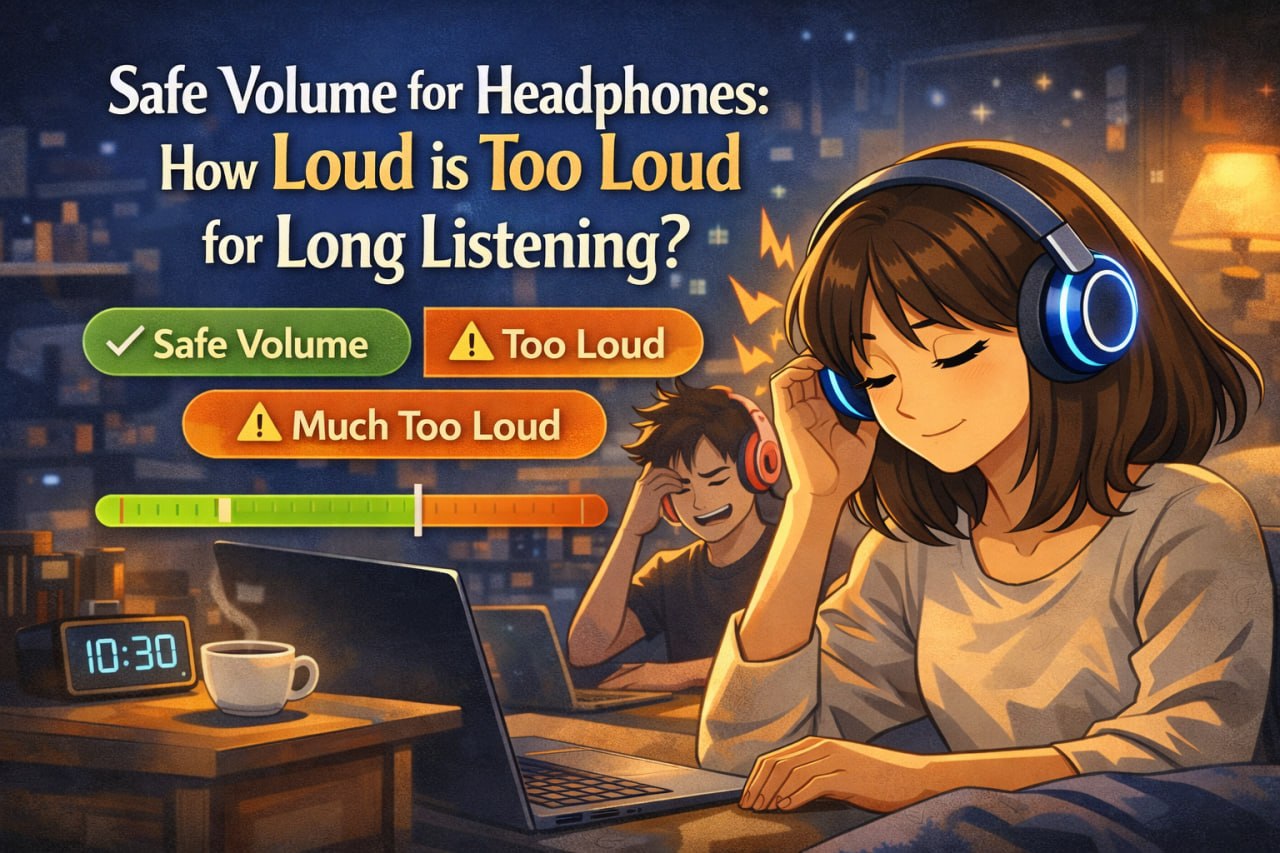
When people ask if listening for hours is “safe,” the real question is usually volume—especially with headphones.
For focus and sleep audio, the goal isn’t maximum intensity. It’s a steady background layer that supports attention or relaxation without causing fatigue.
This guide gives you practical rules you can use immediately—no measuring tools required.
What you’ll learn
- The simplest ways to tell if your volume is too loud
- How to set safe volume for long work sessions and night listening
- Headphones vs speakers: what’s safer and more comfortable
- Why “turning it up” often means your brain needs a break—not more sound
The core rule: “Background” beats “foreground”
For focus or sleep, audio should feel like:
- a soft environment, not a performance
- something you can ignore, not something you track
If you notice the music all the time, it’s probably too loud (or too complex).
5 quick tests to check if your volume is safe
1) The conversation test
If someone speaks to you at normal distance and you can’t understand them at all, it’s likely too loud for long listening.
2) The “after you stop” test
When you pause the audio, do your ears feel like they’re “recovering” or the room suddenly feels oddly quiet?
That’s a sign your volume has been high enough to cause listening fatigue.
3) The “voice in your head” test
If you can’t comfortably think or read because the sound feels intrusive, your volume is too high for focus.
4) The repeatability test
If you listen at this volume today, will it still feel comfortable tomorrow?
Safe listening is repeatable—it doesn’t require “more” over time.
5) The irritation test
If you get tense, irritated, restless, or start grinding through tasks, reduce volume first before changing anything else.
Recommended volume habits (simple and realistic)
For work sessions (headphones)
- Start lower than you think, then increase slightly if needed
- If you’re listening longer than 60–90 minutes, take a short break (even 2–5 minutes helps)
- If you feel the urge to crank volume mid-session, treat it as a break signal
For sleep
- Keep volume low enough that it blends into the room
- If you’re using all-night playback, volume should be barely there
- Avoid sudden changes (ads, notifications, tracks with big jumps)
Headphones vs speakers: which is safer?
Both can be safe. The best choice depends on duration and comfort.
Speakers are often better when:
- You’re playing audio all night
- You’re listening for many hours while working
- You want lower “pressure” on your ears
Headphones are useful when:
- You need isolation (office, commute, shared space)
- You want consistent audio without raising room volume
Practical rule: For very long sessions, speakers usually win on comfort. For noisy environments, headphones win on control—but keep volume low.
Why you keep turning it up (and what to do instead)
If you repeatedly increase volume, it’s rarely because your ears “need more.” It’s usually because:
- your attention is dropping
- your brain wants novelty
- you’re fatigued and chasing stimulation
What to do
Try this sequence:
- Lower volume slightly (yes, lower)
- Take a 2–5 minute break
- Return for a new block
- If you still want it louder, switch tasks or change environment
This keeps sound as a supportive layer instead of a “crutch.”
Break rules for long listening (easy schedule)
You don’t need a strict system. Use one of these:
Option A: light breaks
- Every 60–90 minutes, take 2–5 minutes off audio (or lower it a lot)
Option B: deeper resets (best for heavy cognitive work)
- One focused block (45–90 min)
- 5–10 min break (walk, water, eyes away from screen)
- Start again
Special cases: sleep headphones and kids/teens
Sleep headphones
If you sleep with headphones:
- prioritize comfort and low volume
- avoid hard parts pressing into your ear
- consider speakers if you wake with soreness or irritation
Kids/teens
The safest approach is:
- lower volume
- shorter sessions
- prefer speakers for long listening when possible
FAQ
A safe starting point is “background volume”—low enough that you could still hear someone speaking nearby and it doesn’t feel intrusive.
It can be, especially at low volume with short breaks. The key risk is usually hearing fatigue from volume that’s too high.
That’s often a sign of volume being too high for the duration, or of long uninterrupted listening. Lower volume and add breaks.
Not automatically. Headphones give direct sound to your ears, so low volume and breaks matter more. Speakers are often more comfortable for all-night or very long sessions.
It can be, but comfort is the main issue. Many people sleep better and safer with speakers at low volume.
It’s a signal that you’re using volume for stimulation. Try lowering volume, taking a short break, or switching to simpler audio.
A practical rule is a short break every 60–90 minutes, especially for long sessions.
Reduce volume first. If irritation continues, shorten the session or switch to simpler, more consistent audio.